StartWrightBy StartWright Consulting
When a high-ranking public official casually dismissed protesting students as ‘cockroaches’, what unfolded was a textbook study in subversive brand strategy, rapid-response communications and full-funnel community building.
In a matter of days, Cockroach Janta Party (CJP) compressed two distinct growth phases: achieving 0-to-1 brand creation by turning a slur into a defined identity and executing 1-to-100 hyper-scaling across digital and physical touchpoints.

Phase 1: How Cockroach Janta Party used Virality for 0-to-1 brand creation is a masterclass in modern day brand creation and 0-1 scaling

Aikido Positioning: Turning a threat into a 0-to-1 brand asset
In competitive brand strategy, Aikido positioning involves taking an opponent’s momentum (or an insult) and redirecting it into your core brand narrative.
When the slur was dropped, CJP didn’t try to refute it. They adopted it to complete their 0-to-1 phase overnight.
Why it worked (Key takeaways for 0-1 Brand Building)
- Agile Moment Marketing: They took a single viral spark (the CJI’s remark) and with immense agility, channelled public frustration into a structured movement.
- Stickiness of content: By owning the ‘cockroach’ metaphor, they built instant mental availability. The very name was a distinctive memory structure with ‘mental availability’ and ‘low friction identity’, that was impossible to kill. Mental Availability, because Cockroaches possess an instantly recognizable characteristic: they are virtually impossible to eliminate. By adopting the label for the ‘young and unemployed,’ the brand converted a derogatory metaphor into a symbol of ultimate resilience and survival. And ‘Low-Friction Identity’ because Traditional brand positioning takes months of focus groups to build identity. By reclaiming an existing viral insult, CJP skipped the awareness build phase entirely and jumped straight into market recognition.
Exploiting the ‘Need Gap’: Insight vs. Noise
Every high-growth brand finds a gaping unaddressed need in the market. In the Indian youth demographic, that need gap was clear: systemic anxiety over paper leaks, chronic unemployment and a feeling that legacy institutions were speaking past them.
To understand why CJP’s messaging cut through initially, contrast it with traditional outreach efforts, especially for the youth. When legacy political youth wings staged performative disruptions-such as shirtless protests at technology summits-it highlighted a complete mismatch in tone. The audience saw noise instead of solutions.
| Brand Element | Legacy Youth Outreach | Cockroach Janta Party (Phase 1) |
| Strategy | Attention-seeking stunts | Insight-led positioning |
| Audience Perception | Performative & out-of-touch | Empathetic & hyper-relatable |
| Tone of Voice | Hyper-partisan rhetoric | Self-deprecating satire grounded in real anxiety |
| Core Message | “Look at us” | “We hear you” |
Why it worked (Key takeaways for 0-1 Brand Building (continued)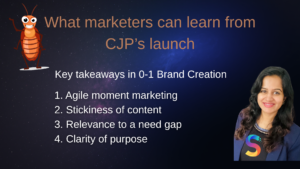
- Relevance to a ‘need gap’: True brand affinity comes from identifying the real, unaddressed pain points of your target demographic and speaking to them without corporate posturing. Legacy parties and media were ignoring the profound systemic frustrations of Gen Z. CJP spoke with this demographic, not at them!
- Clarity of purpose: At its launch, the CJP was a sharp, focused response to the National Eligibility cum Entrance Test (NEET) paper leak scandal, immediately tapping into the raw anxiety of millions of students.
However, as recent developments show, the very tools that fueled CJP’s meteoric rise also triggered its narrative wobble. Thus, this article would be incomplete without examining the recent decay in CJP’s popularity and narrative, detailed in the next section.
Phase 2: When Virality Outpaced Purpose and Cockroach Janta Party’s Narrative Started to Fracture
The current controversy surrounding CJP is not an accident. It is the natural consequence of strategic missteps and a fracturing of that initial clarity. A movement that could have taken the whole country along for critical, generational student reforms botched its initial momentum by drifting from its true purpose.
Here are four lessons in brand decay scaling ventures can learn from CJP’s subsequent trajectory:
- The Meme Paradox: When Visibility Derails Purpose
Memes were the rocket fuel that propelled CJP into national visibility. But memes are an acquisition channel, not a governance framework.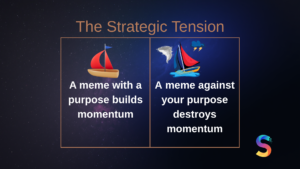
CJP botched its momentum by allowing its initial, purpose-driven virality to degenerate into low-quality digital noise. They traded an authoritative voice for easy clicks by:
- Getting into troll wars with celebrities. Involving Bollywood personalities like Kangana Ranaut in sarcastic feuds might have garnered views, but it sidetracked the serious narrative of educational reform. It was noise, not substance.
- Allowing trolls to set the content agenda. By giving amplification to abusive content or protesters, the brand became associated with performative outrage rather than solution-oriented action.
Key Strategy Takeaway: Never confuse visibility with progress, nor virality with legitimacy. When brands allow sensationalism to dictate their agenda, they trade long-term authority for temporary impressions and invite public suspicion.
- The Danger of “Selective Outrage”: Losing Credibility
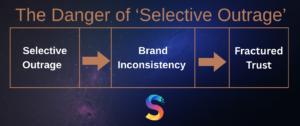 To build a trusted, national brand, a movement must apply its principles consistently. CJP’s early momentum was built on a demand for systemic accountability, not political point-settling. However, CJP faced devastating accusations of ‘selective outrage’ when it remained silent on paper leak controversies in states like Punjab and Jharkhand, while aggressively targeting the central government. This choice allowed critics to frame the student-led movement as a partisan political tool, rather than a genuine call for national reform. By failing to speak up with equal intensity against other regimes, they severely compromised their moral standing and limited their ability to build a multi-partisan consensus for change.
Key Takeaway: A purpose-led brand that applies its rules selectively on political convenience will never have the authority to lead it. Credibility requires consistency, regardless of the political color of the state government.
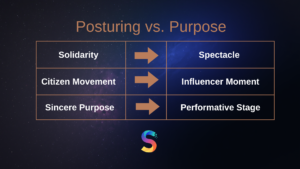
- Posturing vs. Purpose: Losing the Moral Centre No brand can survive a moral dissonance between its message and its actions. The backlash over venue celebrations served as a case study in optical dissonance. At a time when student families who died by suicide were still fighting for justice and systemic educational reforms remained unrealized, visuals of dancing and celebration created a devastating rift. Even as spokespeople clarified the event was meant to debrief exhausted volunteers, the visual narrative signaled a fundamental shift.
This sense of premature celebration-mistaking a tactical victory (a minister’s resignation) for a strategic goal (generational reform)-alienated advocates and student communities who were vociferous in their support to the CJP protests at Jantar Mantar. While the party spokesperson clarified that GenZ can party as well as protest at the same time, that clarification did little to undo the damage that had been done.
Key Strategy Takeaway: Purpose-led brands must preserve humility, sincerity and physical proximity to the public that birthed them. High-growth brands must celebrate milestones with their community, not away from them and never before the work is truly done.
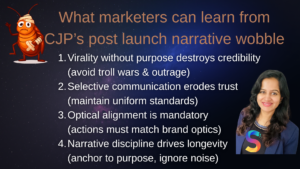
- The Final Principle: Singularity and Sincerity of Purpose
A brand can survive platform bans and competitive attacks, but it cannot survive the dilution of its purpose.
CJP botched its momentum because it failed to protect its initial mission from three destructive forces:
- Dilution: Chasing every trending topic, from troll wars to personal political confrontationalism, made their original mission for educational merit and transparency feel secondary.
- Distraction: They allowed abusive rhetoric and personality clashes to become the primary focus of their communications.
- Distortion: They created a perception that they were not fully showing up for critical issues outside of the primary media nodes, creating an impression of a failure to build a truly national coalition for reform.
So what should Cockroach Janta Party do now?
The good news is brands can attempt a strategic reset and regain their momentum by returning to their true purpose. This brings us to the last section of this article.
The Strategic Reset Protocol: How to Turn Wildfire Back Into Rocket Fuel
When a brand is caught in a narrative wildfire, every attempt to simply ‘market your way out’ of it will fail. For the Cockroach Janta Party (CJP) and for any scaling corporate brand that finds its purpose being eclipsed by controversy-there is only one path to recovery: A Narrative and Operational Reset.
Likewise, if CJP wants to regain its legitimacy and build a truly national coalition for generational student reform, they must execute a structured strategy that moves from apology to re-alignment.
Here is the four-step protocol scaling brands must follow to arrest narrative decay:
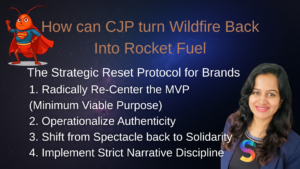
- Radically Re-Center the MVP (Minimum Viable Purpose)
You must strip your brand messaging back down to its original, unbreakable promise. CJP must drop the celebrity troll feuds, the personal political confrontation, and the vanity metrics.
- The Action: A formal, humble statement from leadership acknowledging that the movement drifted from its true center (NEET reform). Re-state the original mission as the sole focus of the brand’s future energy.
- Operationalize Authenticity
Words mean nothing without structural change. To counter the narrative of selective outrage, CJP must demonstrate that their principles apply universally.
- The Action: They must visibly and vocally show up for student issues outside of the primary media centers. By actively protesting paper leaks in non-BJP states like Punjab and Bihar with equal intensity, they convert partisan posturing into genuine national leadership.
- Shift from Spectacle back to Solidarity
You must actively disconnect from the influencer moment and reconnect with your core customer base’s pain points.
- The Action: Replace the celebrate-in-private optics with protest-in-public humility. Instead of ‘5-star’ de-briefings, the visuals must return to sharing space with students at Jantar Mantar or on the ground in state capitals-preserving physical and visual proximity to the struggle.
- Implement Strict Narrative Discipline
You must take back the agenda from the trolls. Corporate brands cannot afford to let online sensationalism dictate their core values.
- The Action: Establish clear, internal communication protocols. Leadership must draw a hard line that abusive protest amplification is a violation of brand standards. The messaging must shift entirely from attacking people to attacking the broken system.

Final Thoughts: Success Demands Narrative Consistency
The complete trajectory of the Cockroach Janata Party demonstrates that success in modern communication does not belong to the loudest voice or the biggest budget. It belongs to the voice with clarity of purpose, narrative discipline and optical alignment.
For founders, CMOs and growth strategists, the CJP trajectory offers a complete framework-not just on how to scale a brand overnight, but on how narrative drift, performative posturing and unchecked optics can derail even the strongest movement.
Whether you are scaling a tech venture or building a consumer brand, the verdict is final: Purpose is not just a marketing hook- it is your brand’s true centre of gravity. Lose it to distraction or elite posturing and the brand collapses. Protect it with sincerity and consistency and the brand endures.

Design an insight-led narrative and full-funnel marketing plan
Book a clarity call today!
SHWETA SHRIVASTAVA
 Shweta Shrivastava is a senior Marketing and Strategy leader turned start-up mentor. Having served as Marketing Head across large multinational companies, Shweta is currently an Investor & advisor to health and consumer tech start-ups in the Asian markets. Passionate about the intersection of healthcare and technology in democratising healthcare, Shweta features her blogs at StartWright Insights page. To get more updates on upcoming trends in healthtech and consumer tech, please follow her on linkedin or twitter